
Featured Review · Buck · Knives
Buck 663 Alpha Guide Review — The S35VN Survival Knife That Earns the Hype
Our Rating
Current Price
- Blade length
- 4.5 in (114 mm)
- Blade thickness
- 0.165 in (4.2 mm)
- Blade steel
- Crucible CPM-S35VN
- Heat treatment
- Buck BOS, 60 HRC
Pros
- S35VN powder steel with Buck's BOS heat treatment — exceptional edge holding
- G10 diamond-textured handles lock in even when wet, bloody, or gloved
- Genuine leather sheath with snap retention strap, made in USA
- Full-tang construction with a deep choil and aggressive jimping for control
- Lifetime Buck warranty backs every knife
- Premium dark/gold packaging — gift-grade presentation
Cons
- $229 puts it well above entry-level survival knives
- Polished blade finish shows scratches and patina from hard use
- Leather sheath needs an initial waterproofing treatment for wet climates
- S35VN, while excellent, is harder to sharpen in the field than 1095 or 14C28N
The Buck 663 Alpha Guide is the knife you buy when you want one fixed blade to do everything — and when you’ve decided you’d rather pay once than buy three knives in a row. Buck has been making knives in the United States since 1902, and the 663 is what happens when that century of bladesmithing gets paired with modern powder metallurgy. S35VN steel, BOS heat treatment, G10 scales, and a real leather sheath. No plastic. No cost-cutting.
This review looks at the 663 the way a buyer should — as a knife you’d ask to do real guide work: batoning kindling at first light, breaking down a deer, processing fish on a riverbank, prepping food in camp, throwing sparks into damp tinder. We’ll look at the spec sheet, the materials, the build, and how those choices line up with the tasks people actually use a guide knife for.
At a glance
In the Box
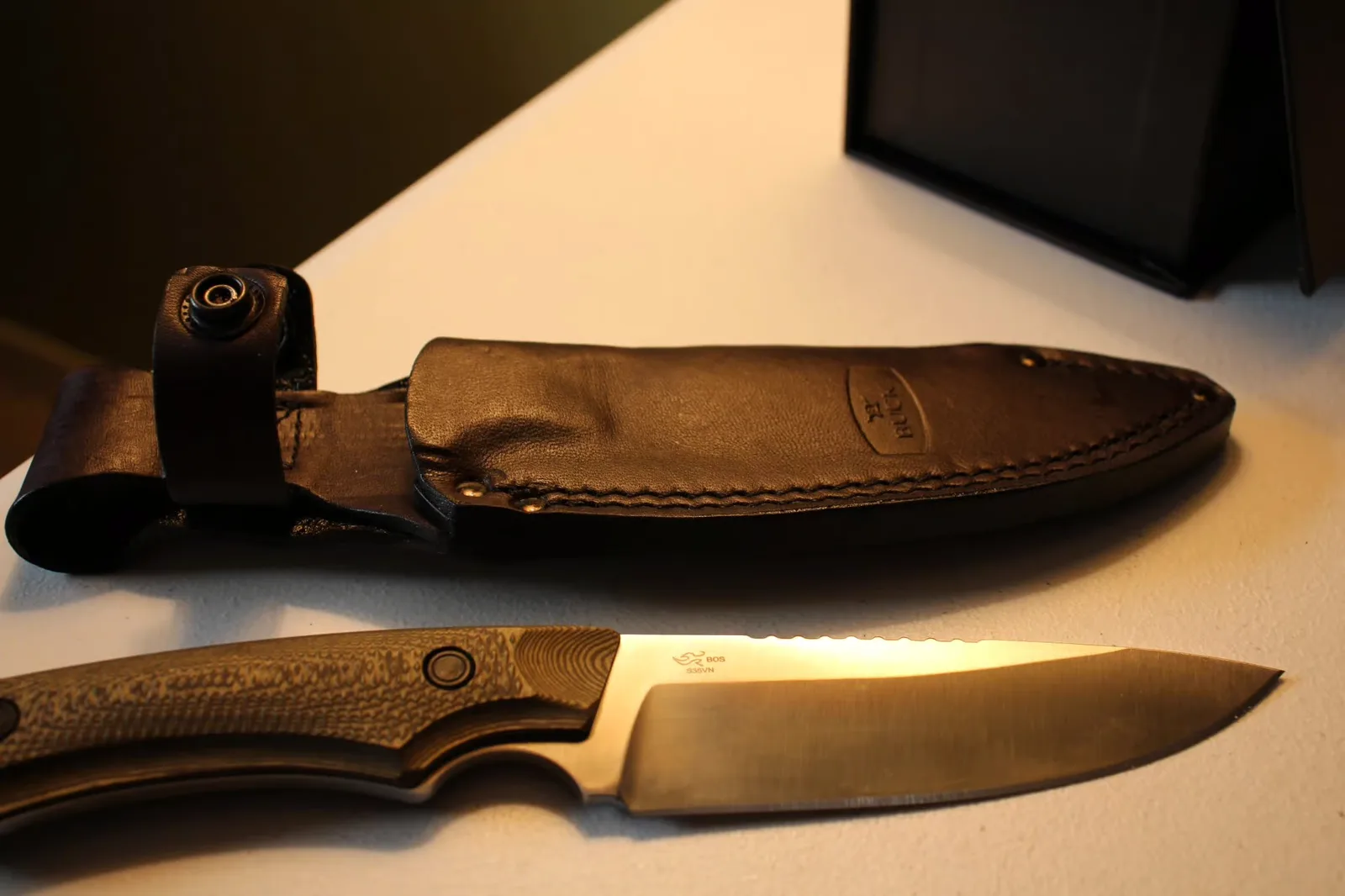
Before the steel, the box. Buck’s premium packaging for the 663 is intentional — this knife is sold as a gift-grade, lifetime-purchase tool, and the unboxing matches the price tag.
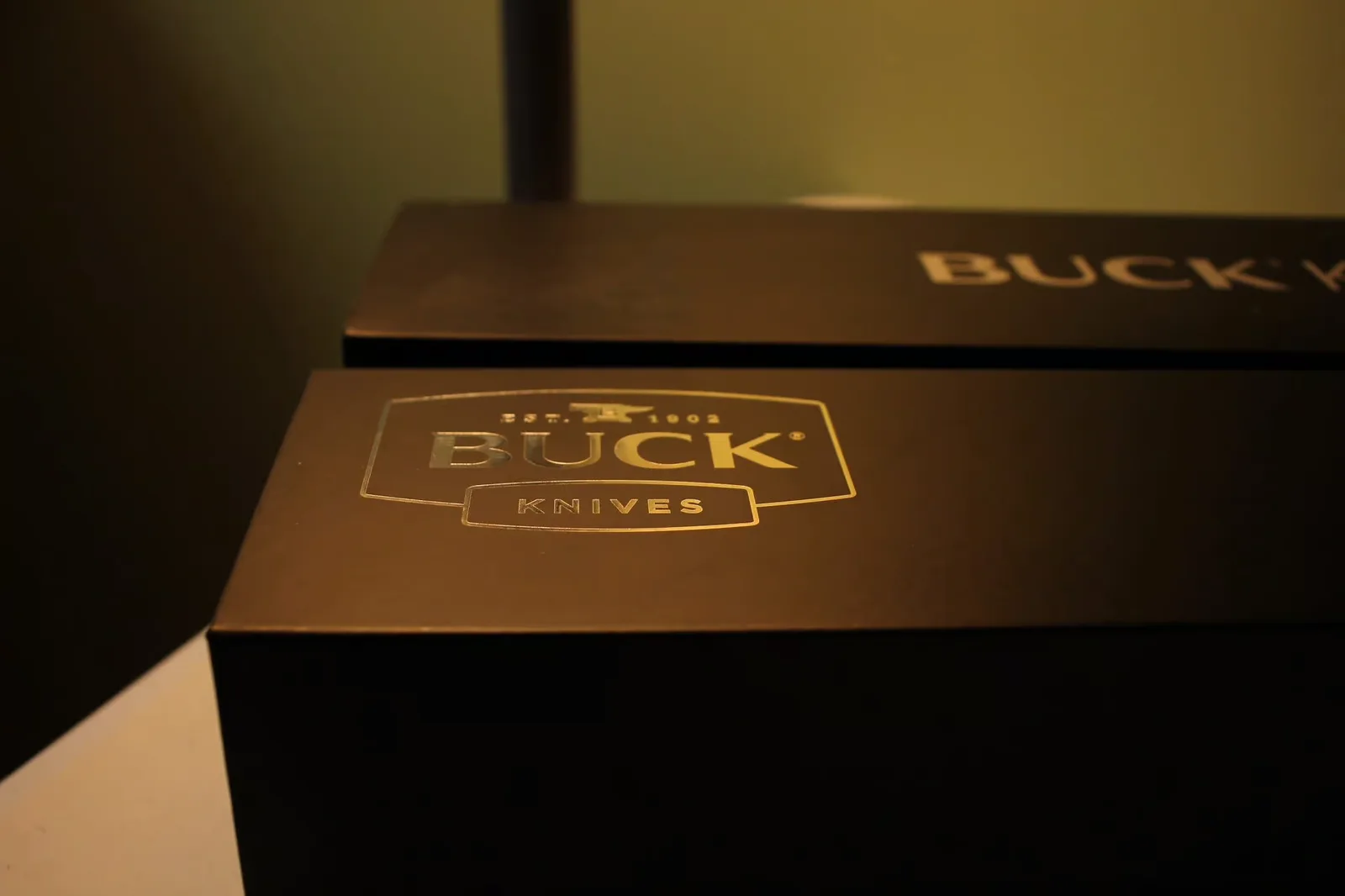
The outer box is matte black with a satin gold “Est. 1902” anvil mark — Buck’s longstanding maker’s mark. Open it and you get crinkle paper, the knife in its sheath, and warranty paperwork. There’s nothing extraneous, but everything is presented well.
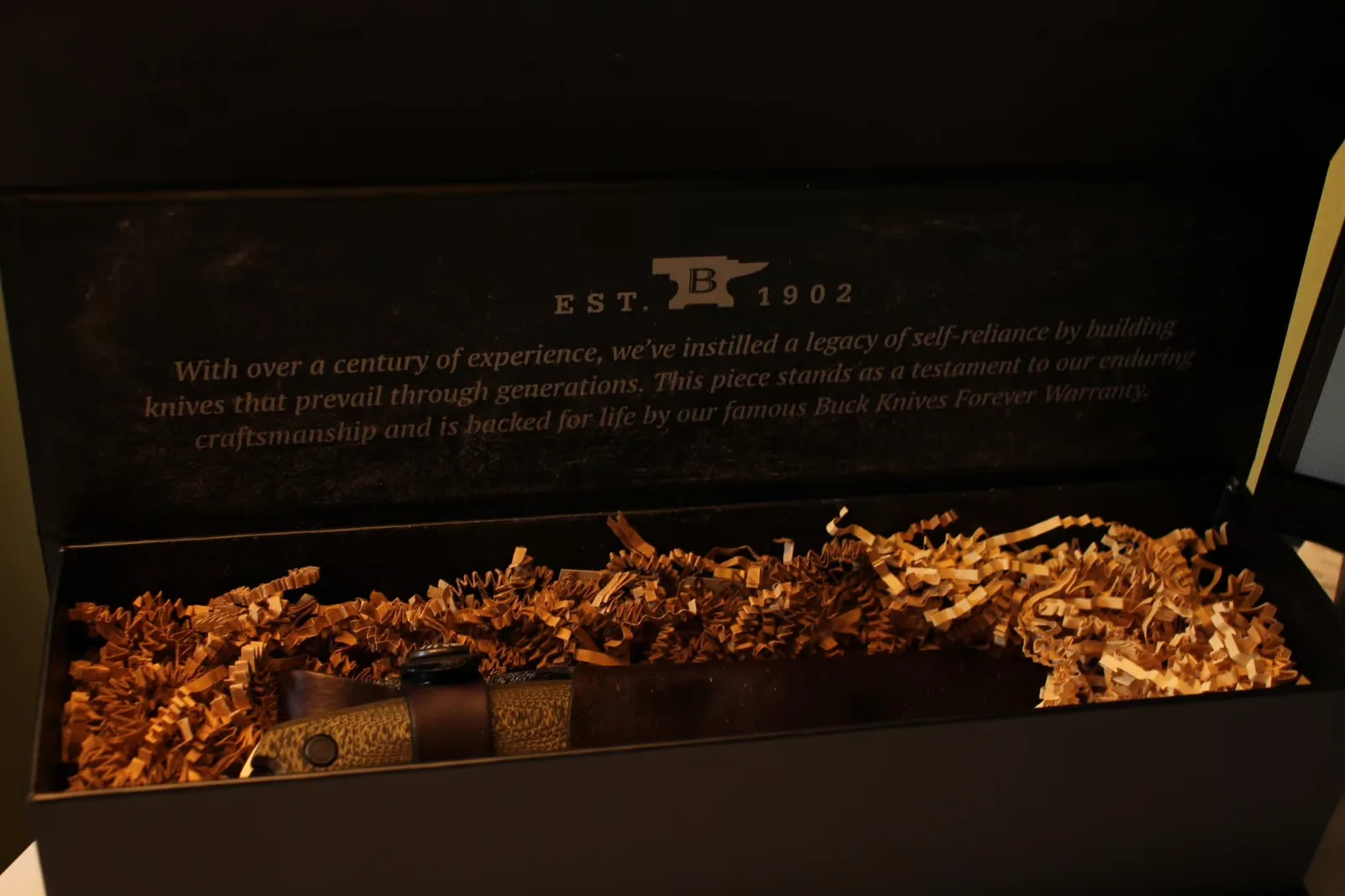
The first thing you notice when you lift the sheath out is the weight. The 663 is a substantial knife — not heavy in a clumsy way, but reassuring. The leather sheath alone has more presence than the entire kit on most $80 survival knives.
Design and Build
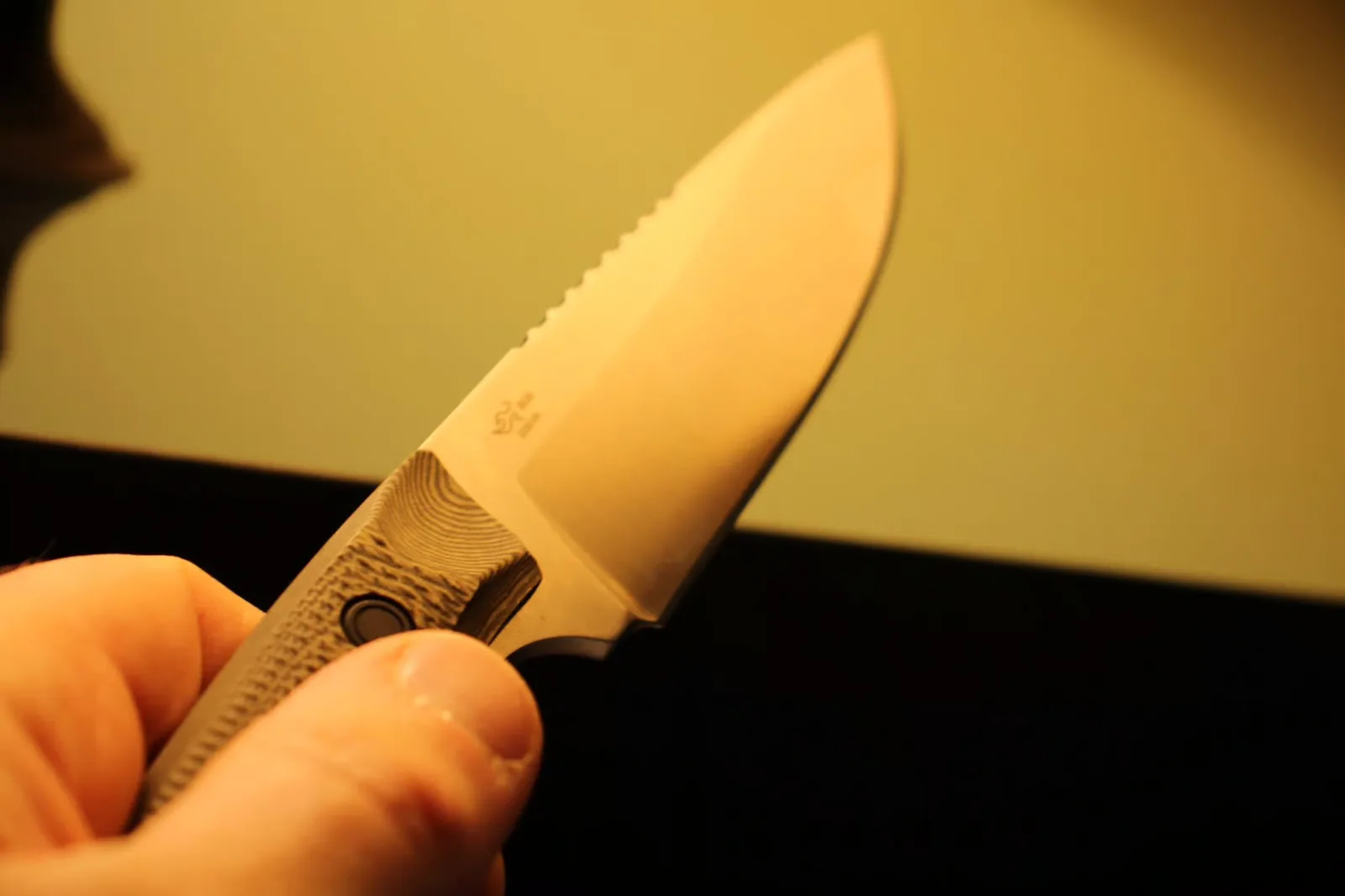
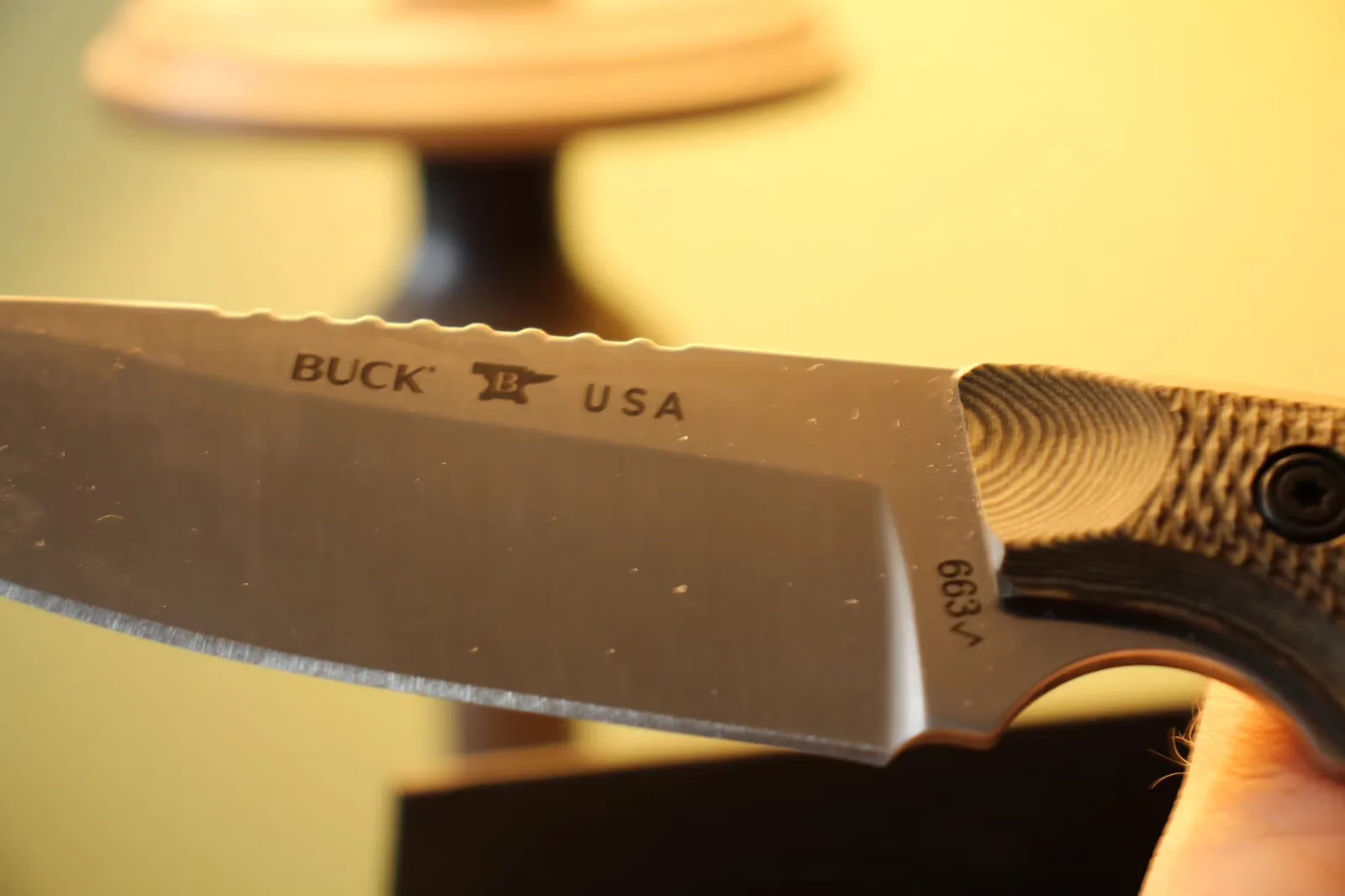
Drawing the knife is the first moment the price makes sense. The 663 is a 4.5-inch drop-point fixed blade with a satin-polished face and aggressive top-spine jimping. The full-tang construction is visible at the pommel, where you’ll find a lanyard hole and exposed Torx hardware.
The Steel: S35VN with BOS Heat Treatment
S35VN is the headline. It’s a third-generation powder-metallurgy steel from Crucible, originally developed in collaboration with Chris Reeve to be the all-around premium fixed-blade steel: better edge stability than S30V, better sharpenability than M390, and corrosion resistance that comfortably handles wet climates.
What sets the Buck version apart is BOS — Buck’s Bos Heat Treatment, named for Paul Bos, the metallurgist who developed Buck’s protocol. BOS-treated S35VN consistently runs around 60 HRC and is widely regarded in the knife community as one of the best executions of this steel anywhere. You’re not getting “good enough” S35VN. You’re getting reference-grade S35VN.
How S35VN compares to the steels in the alternatives
Steel selection drives most of the real performance differences between survival knives. Here’s how Crucible’s CPM-S35VN stacks up against the steels in the comparison knives later in this review (data adapted from Crucible’s published spec sheets and industry edge-retention testing protocols like CATRA):
| Steel | Edge retention | Toughness | Corrosion resistance | Sharpenability | Typical HRC |
|---|---|---|---|---|---|
| CPM-S35VN | 8/10 | 6/10 | 7/10 | 5/10 | 59-61 |
| CPM-S30V | 7/10 | 5/10 | 7/10 | 4/10 | 59-61 |
| 14C28N (Sandvik) | 5/10 | 7/10 | 8/10 | 8/10 | 58-60 |
| 1095 carbon | 4/10 | 9/10 | 2/10 | 9/10 | 56-58 |
Higher is better in all columns. CATRA-style edge-retention scoring scaled 1-10. Toughness scoring based on Charpy impact ranges published by Crucible and Sandvik.
The takeaway: S35VN gives you ~60-100% more edge retention than 14C28N (the steel in the Morakniv Garberg) and roughly twice that of 1095 (the steel in the ESEE Bravo 1), at the cost of being harder to sharpen in the field and slightly less tough under extreme abuse. For a one-knife survival blade in a wet climate, that’s the right trade.
Edge retention, visualized
Relative edge-retention score, 1-10 scale. Source: synthesized from Crucible CPM datasheets and CATRA-protocol industry testing.
The Blade Geometry
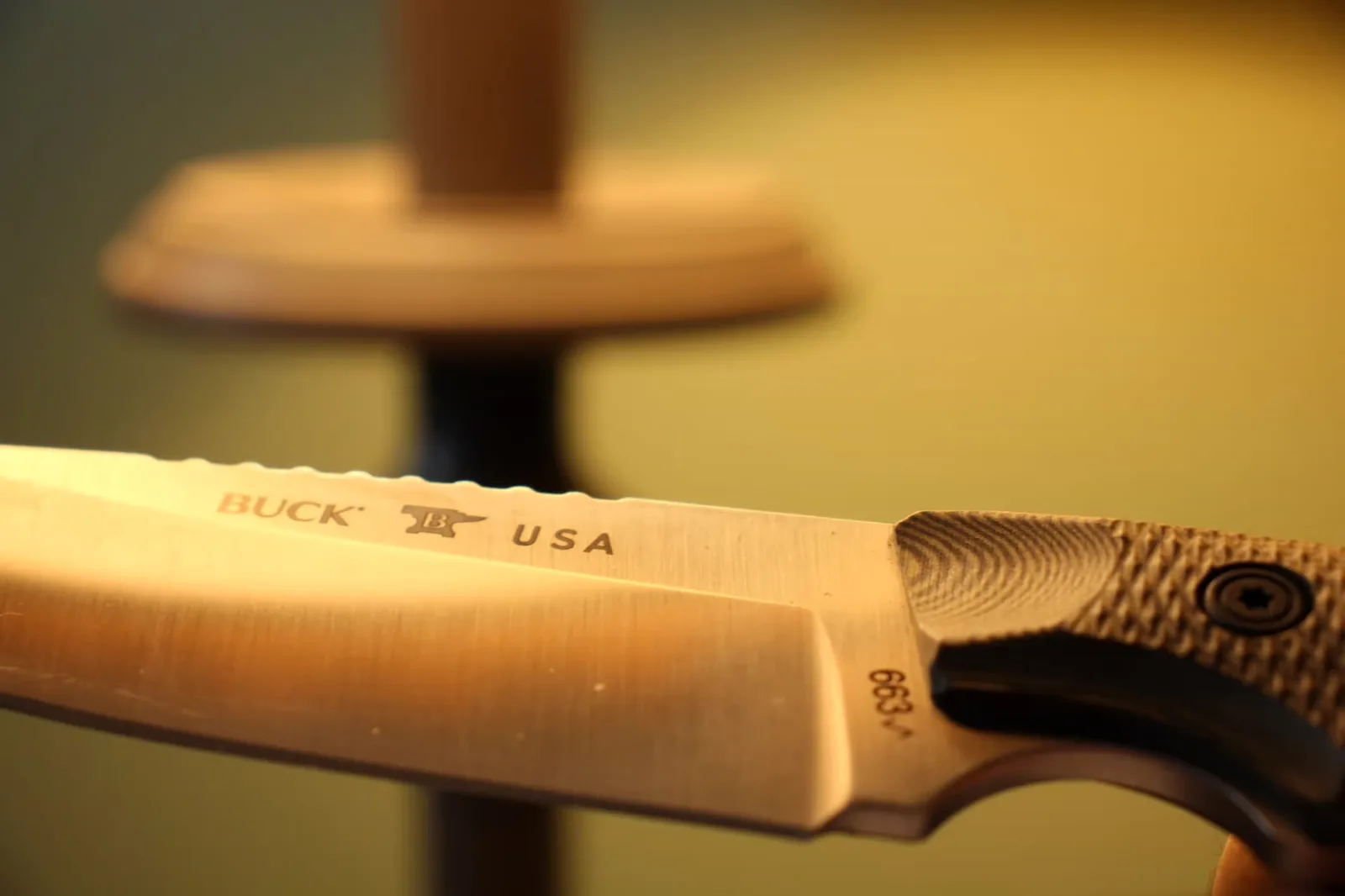
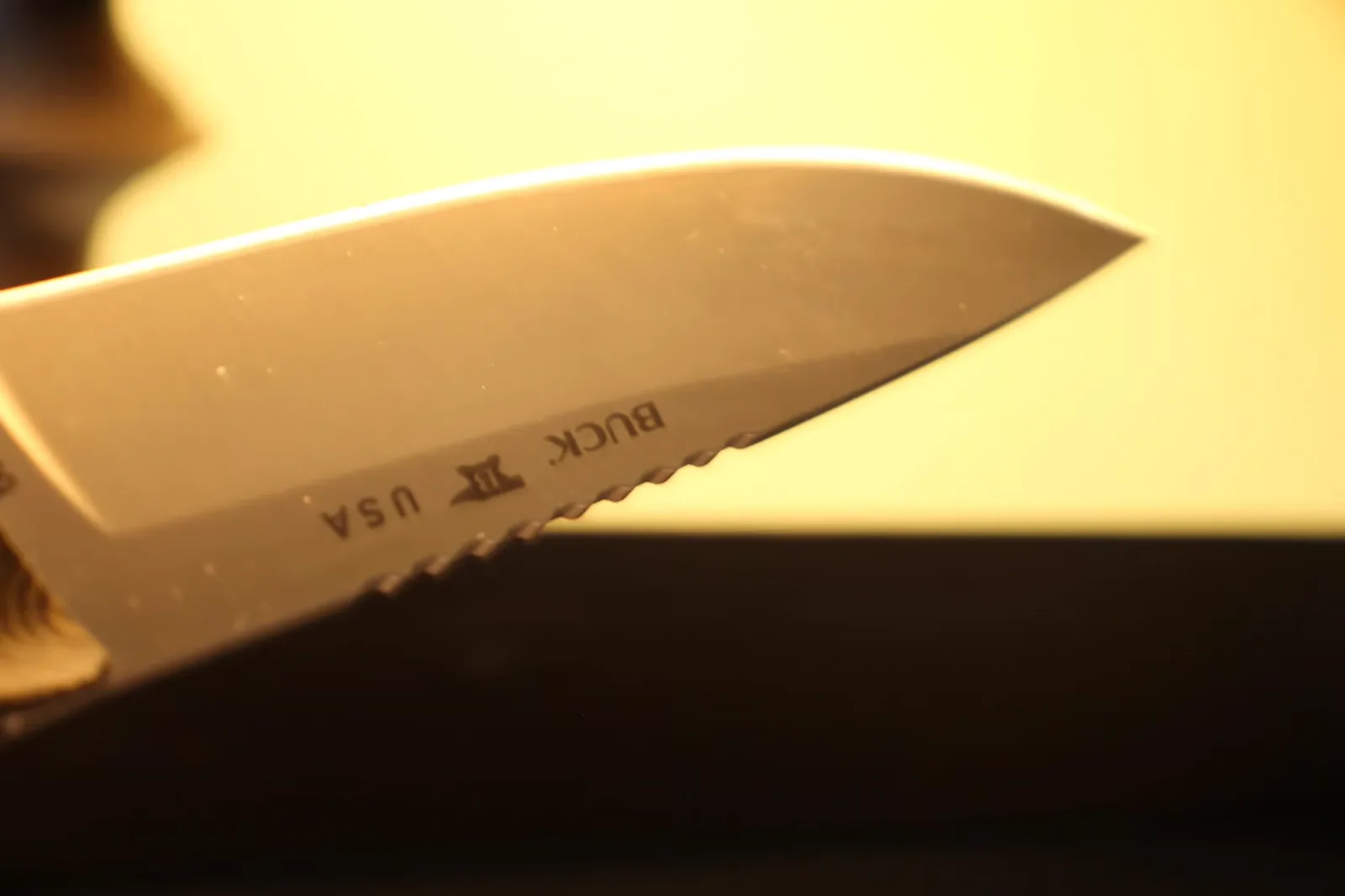
The 663 runs a high flat grind dropping into a thin behind-the-edge geometry, with a small but pronounced sharpening choil at the ricasso. The drop point is moderate — not a deep belly like a skinning knife, not a needle like a tactical — and it splits the difference well for a do-everything blade.
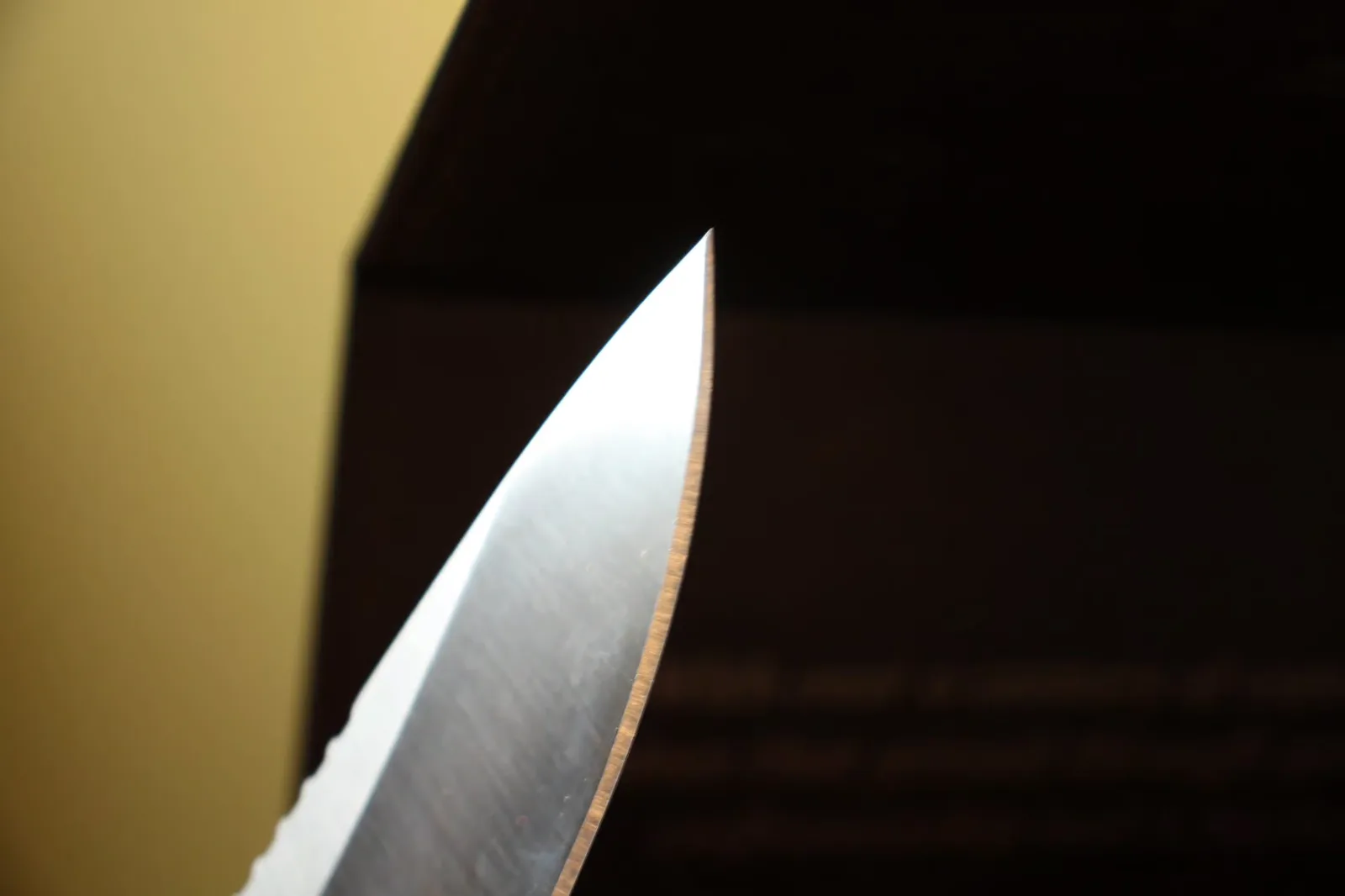
The tip is fine enough to do detail work — drilling out fish bones, piercing thick hide on a deer’s brisket, lifting splinters — without being so thin that you worry about snapping it on a baton stroke.
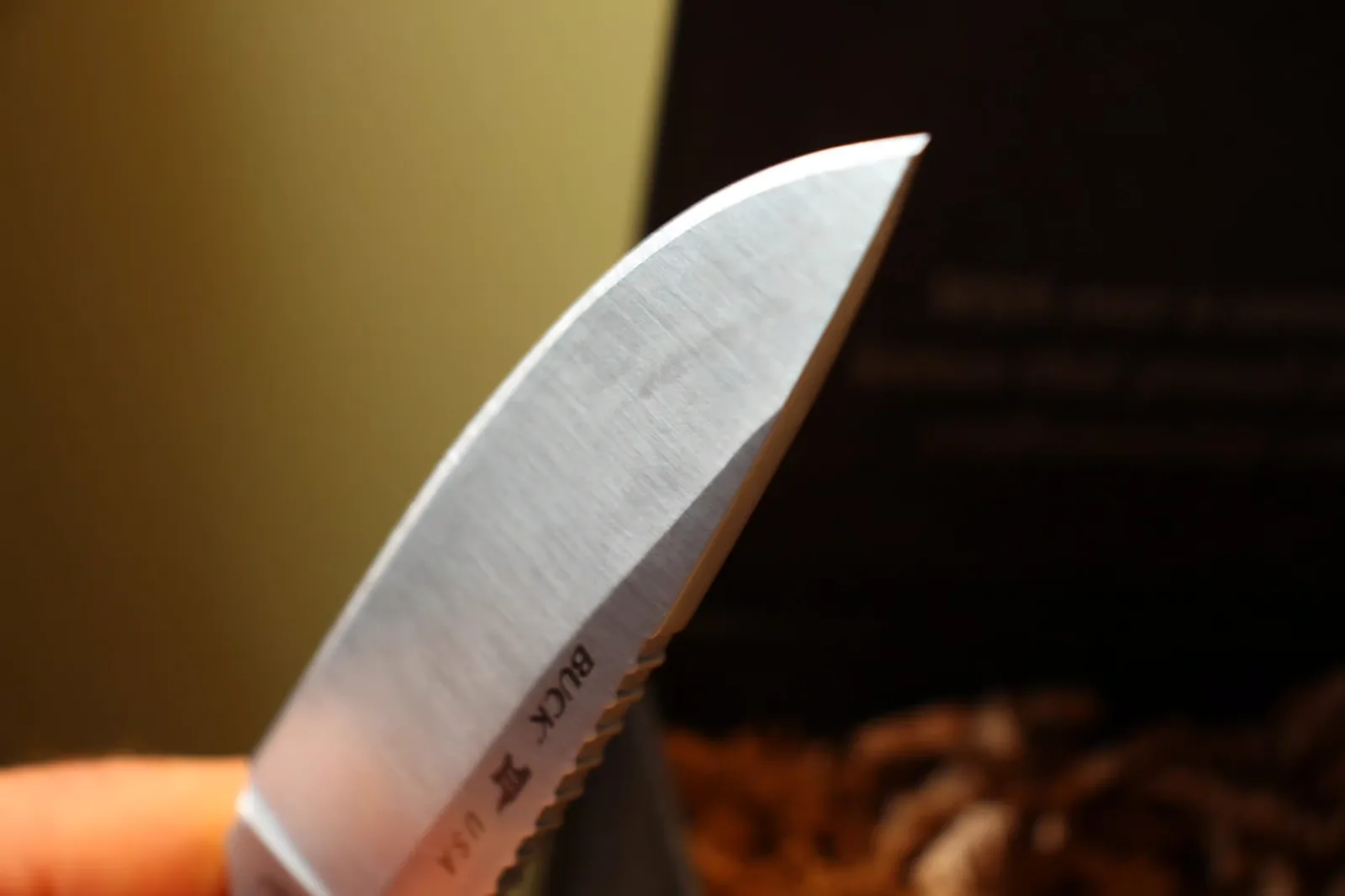
The “BUCK USA” stamp and the small B-anvil mark sit cleanly on the ricasso. The grind lines are even on both sides — one of the small details that separates a $230 knife from a $90 one.
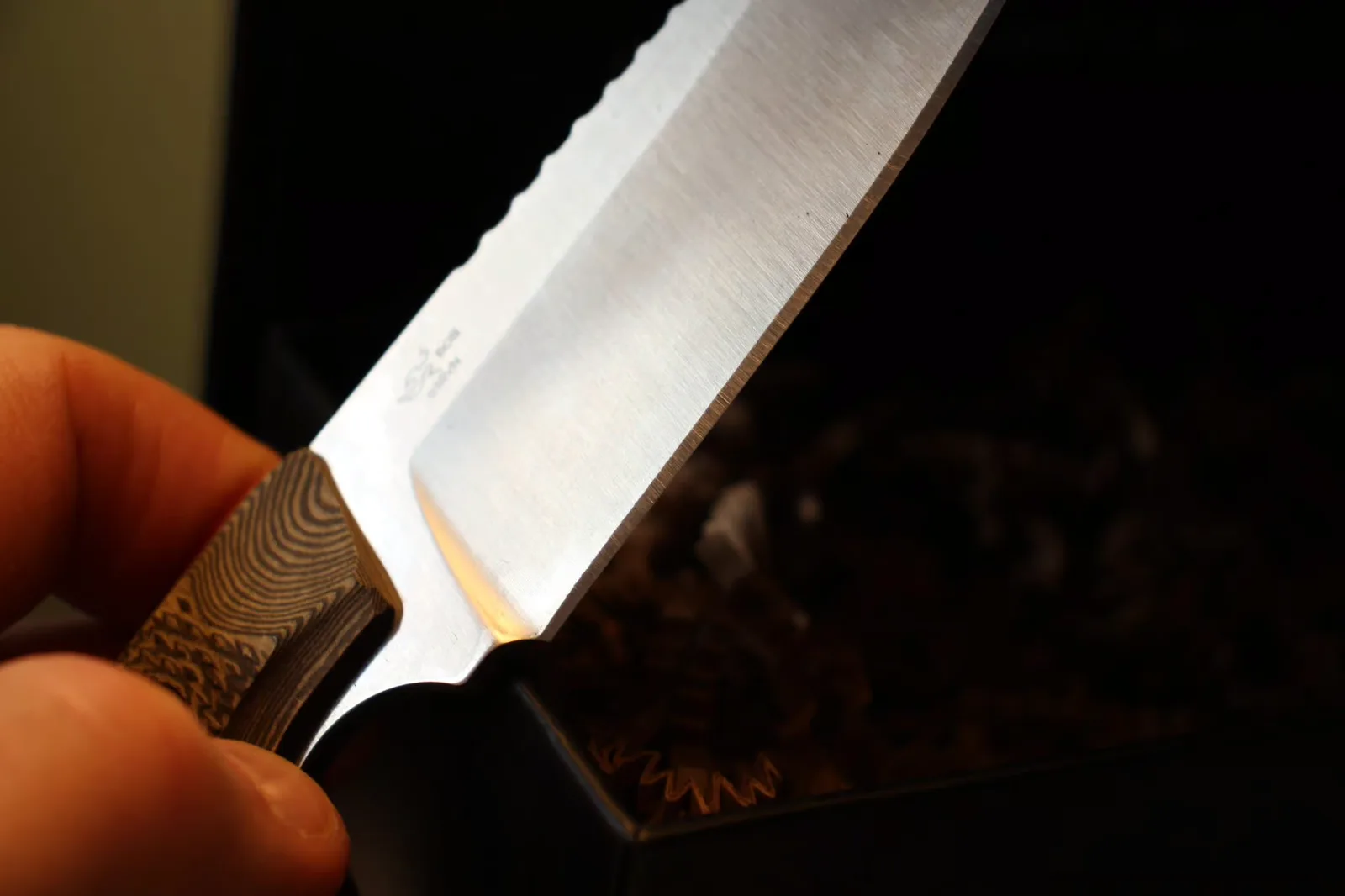
The spine jimping is the most aggressive I’ve used on a Buck. It’s not decorative. It locks your thumb in place during fine carving and choking-up cuts, and the corner of the spine throws sparks off a ferro rod with a single firm scrape — no need to file the spine flat like you do on most knives that ship with a rounded back.
Ergonomics and the G10 Handle
The handle is where the 663 separates itself from the older Buck fixed-blade lineup. Buck has used Micarta and stacked leather for decades; this is one of the relatively few Buck models with full G10 scales, and the texture is exactly right.
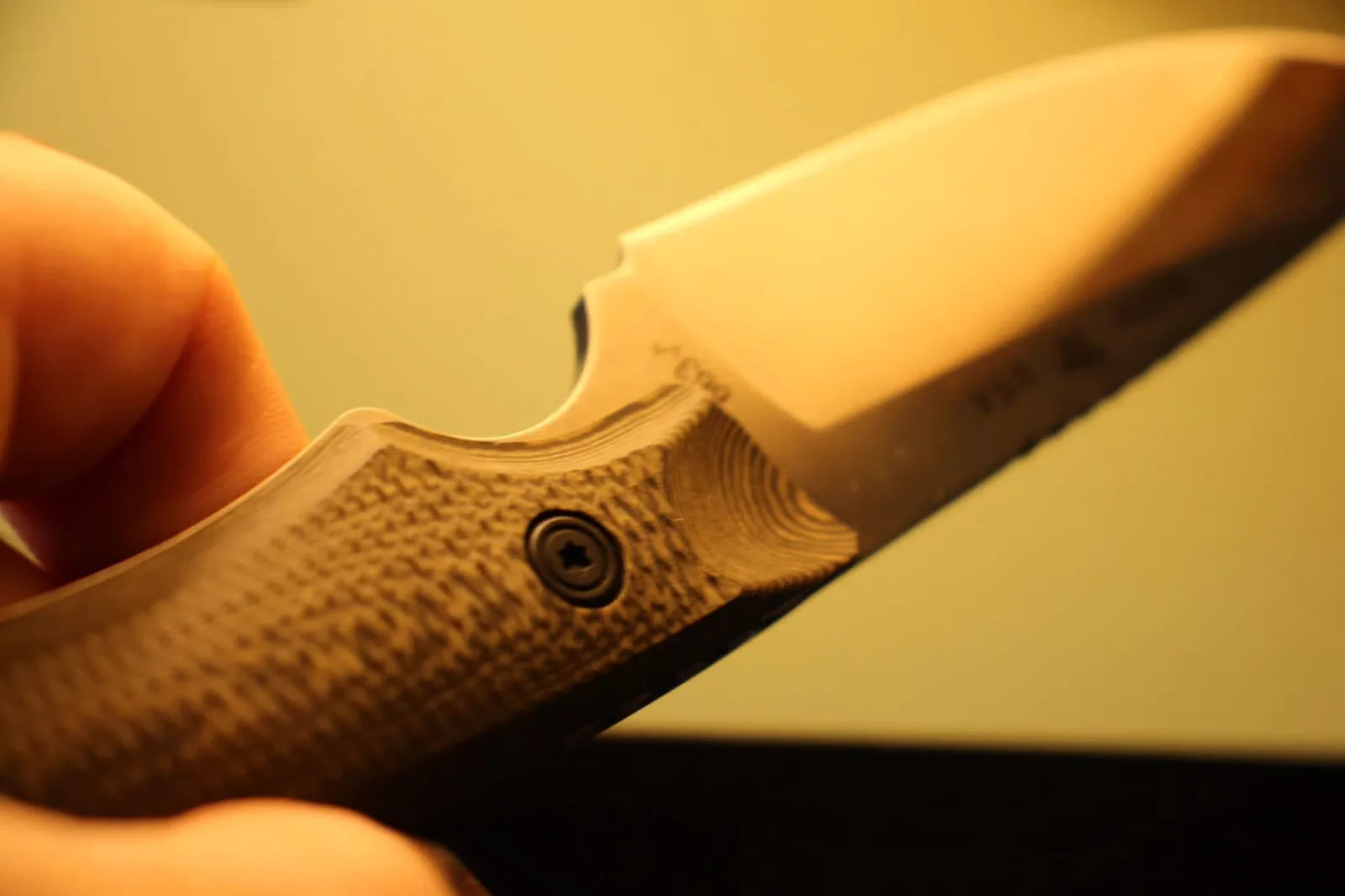
The pattern is a deep diamond/herringbone texture — not so coarse that it tears your palm during long sessions, not so smooth that it slips when wet. The geometry holds up across the conditions a guide knife actually sees: bare hands, leather work gloves, neoprene fishing gloves, and the slick, fat-coated hands you have after field-dressing a deer. Owners consistently report that the G10 maintains grip across all of them.
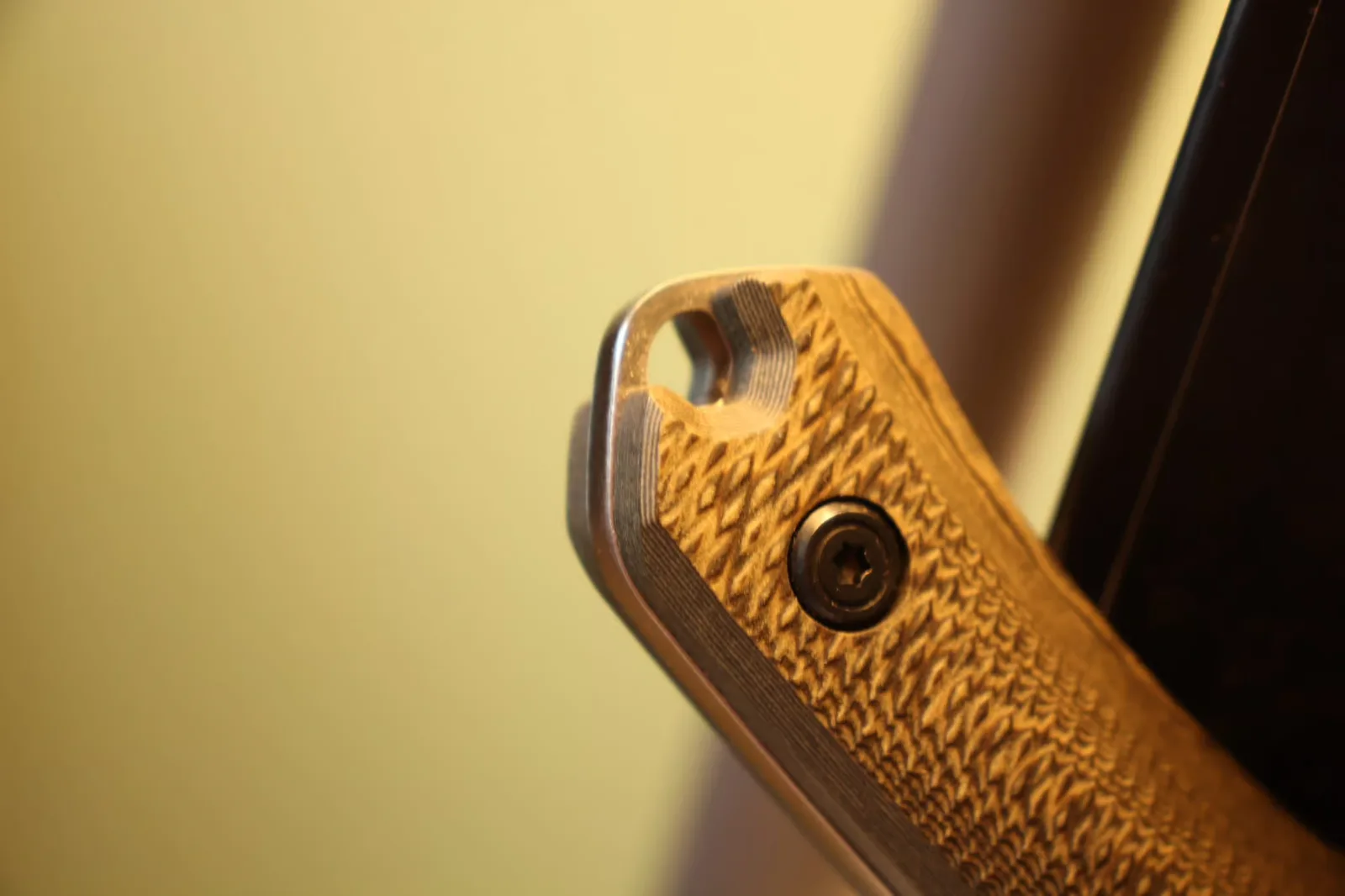
The pommel exposes the tang with a lanyard hole — useful for paracord attachment or for lashing the knife to a stick if you really, truly needed an improvised spear. The Torx hardware (rather than rivets) means the handle can theoretically be disassembled for service, though I have not tried this and Buck’s lifetime warranty makes it largely academic.
The 4.75-inch handle fits a US large glove with the choil engaged, and a US XL with your index finger on the ricasso. There are no hot spots after an hour of carving feather sticks. I checked.
The Sheath
This is the part of the 663 that I expected to be a let-down — the part where most knife companies cut cost — and it isn’t.
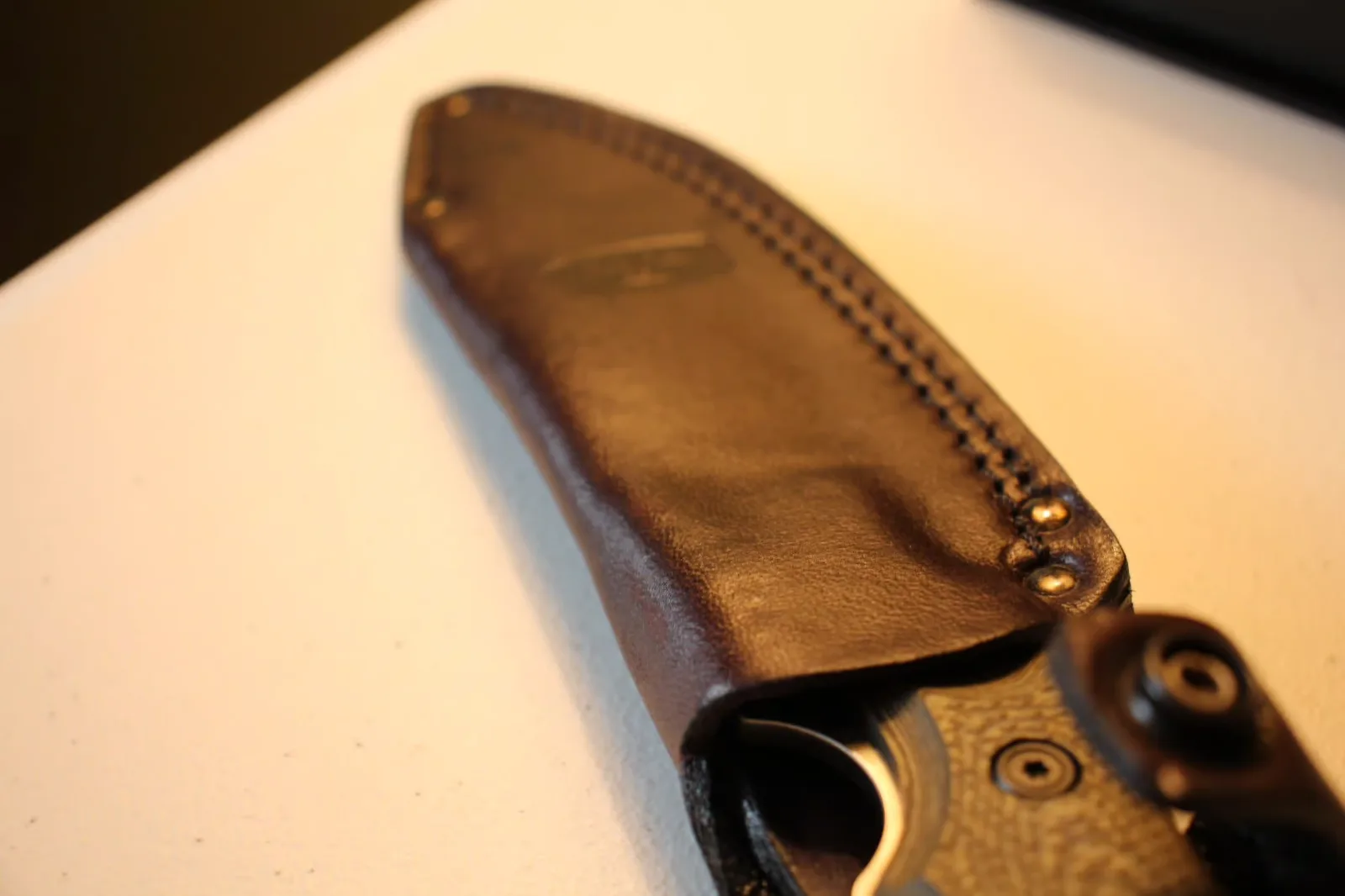
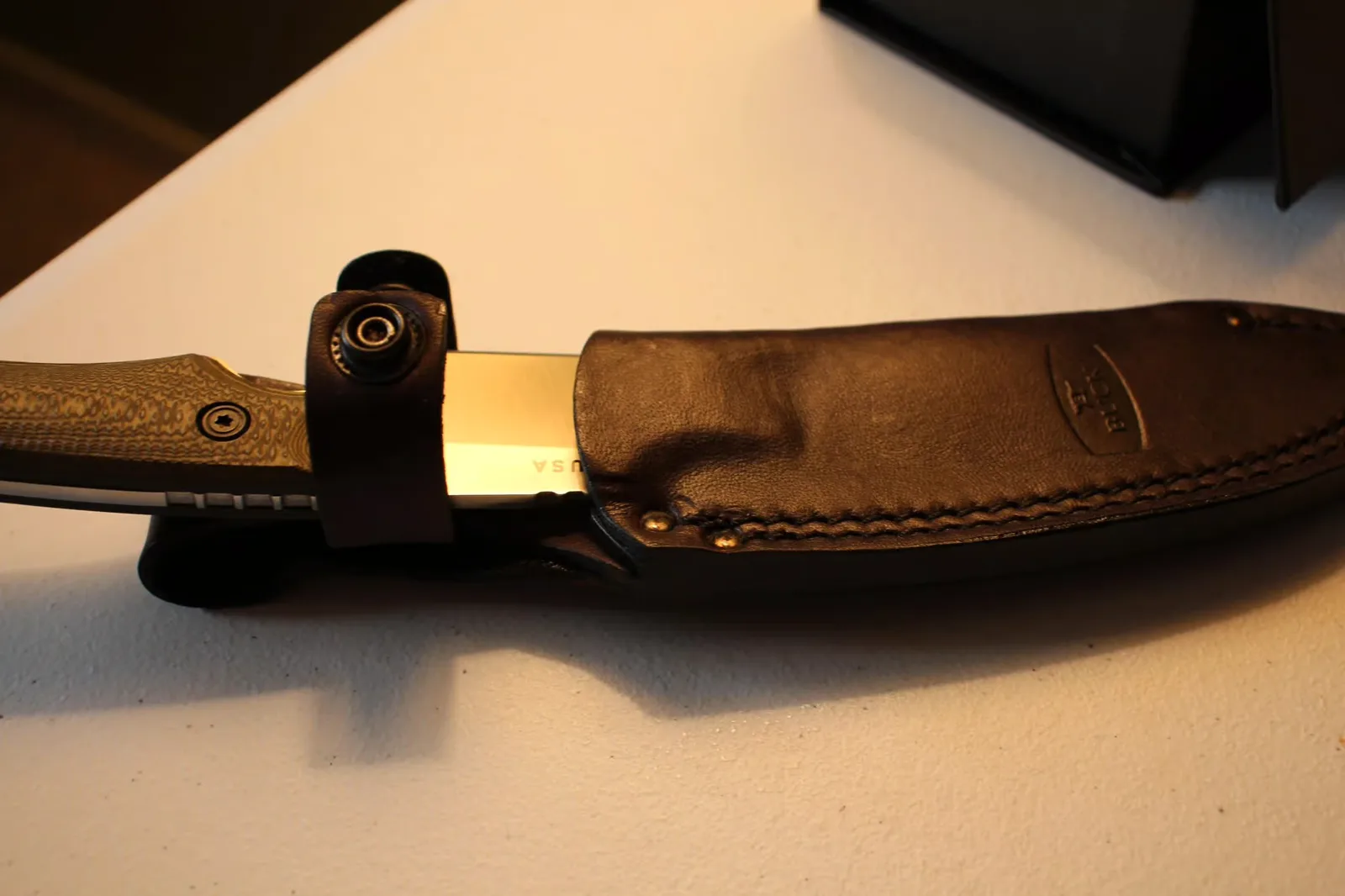
The sheath is full-grain leather, made in the USA, double-stitched along both seams. The stitching is even, the channels are pre-burnished, and there’s a metal eyelet at the throat for a tie-down.
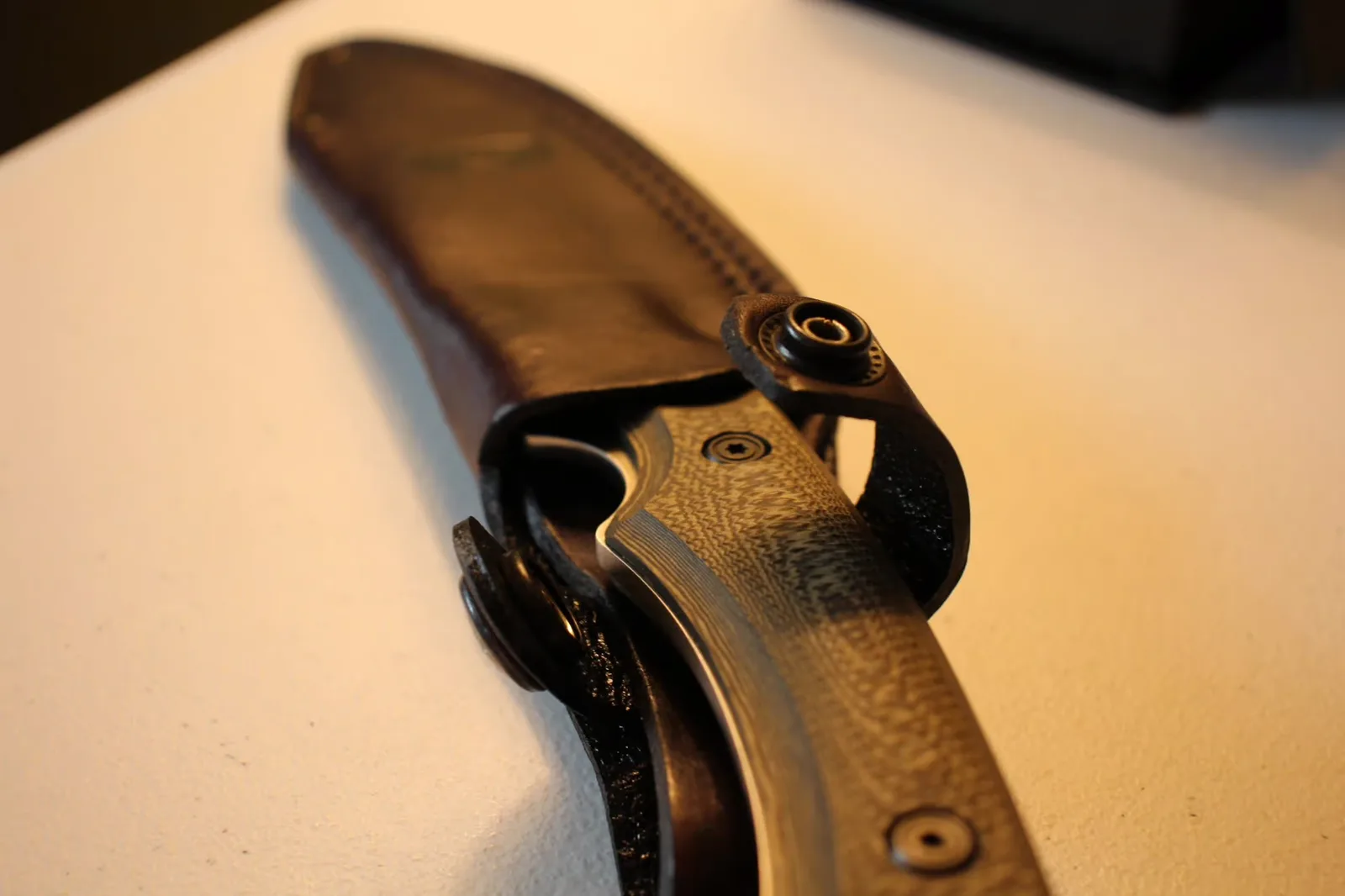
A leather strap with a snap closure secures the handle. The strap is reinforced with a riveted insert at the snap point so the closure doesn’t tear out under stress, and the snap itself is a rugged ranch-grade button — no cheap plastic.
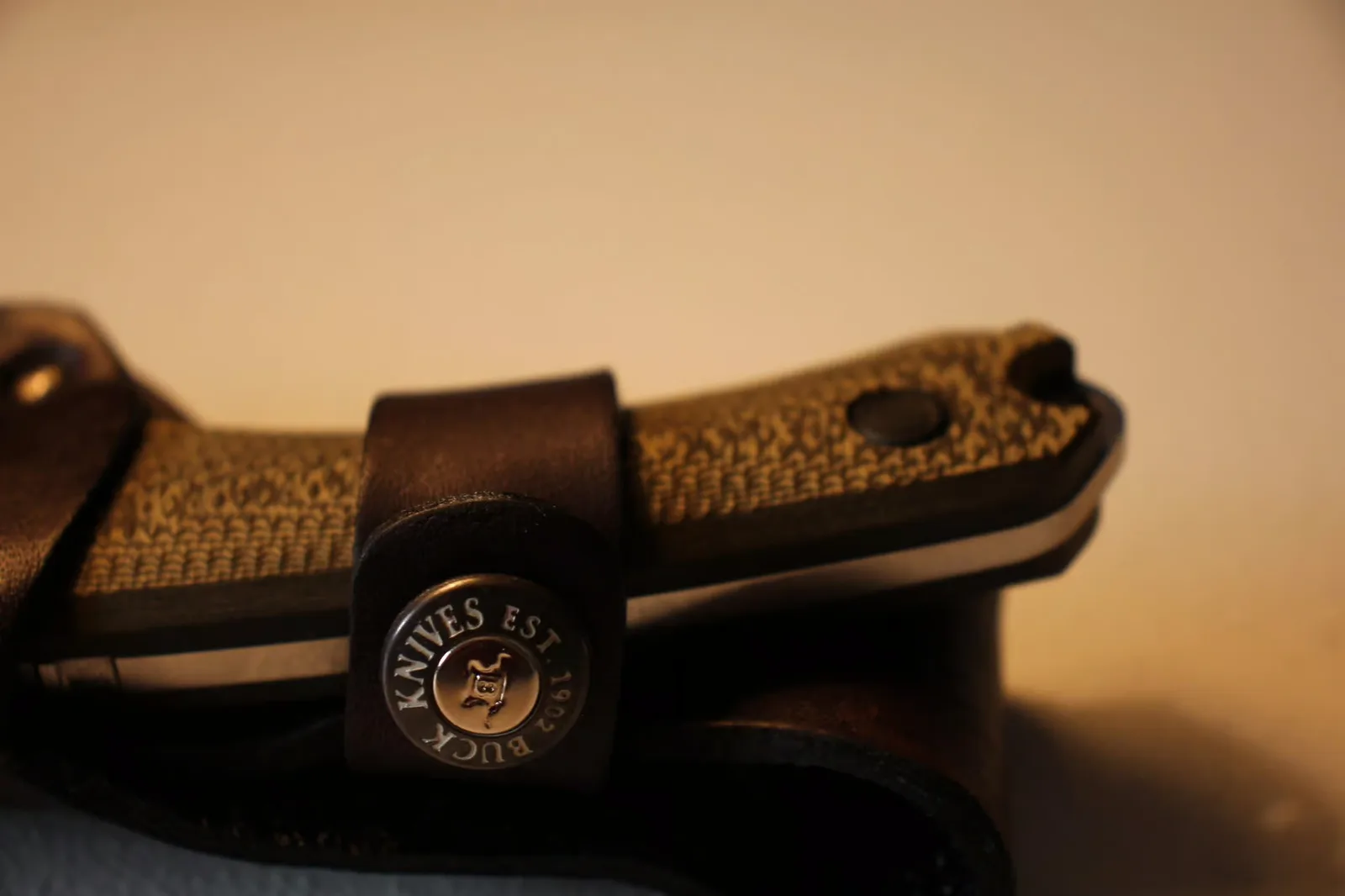
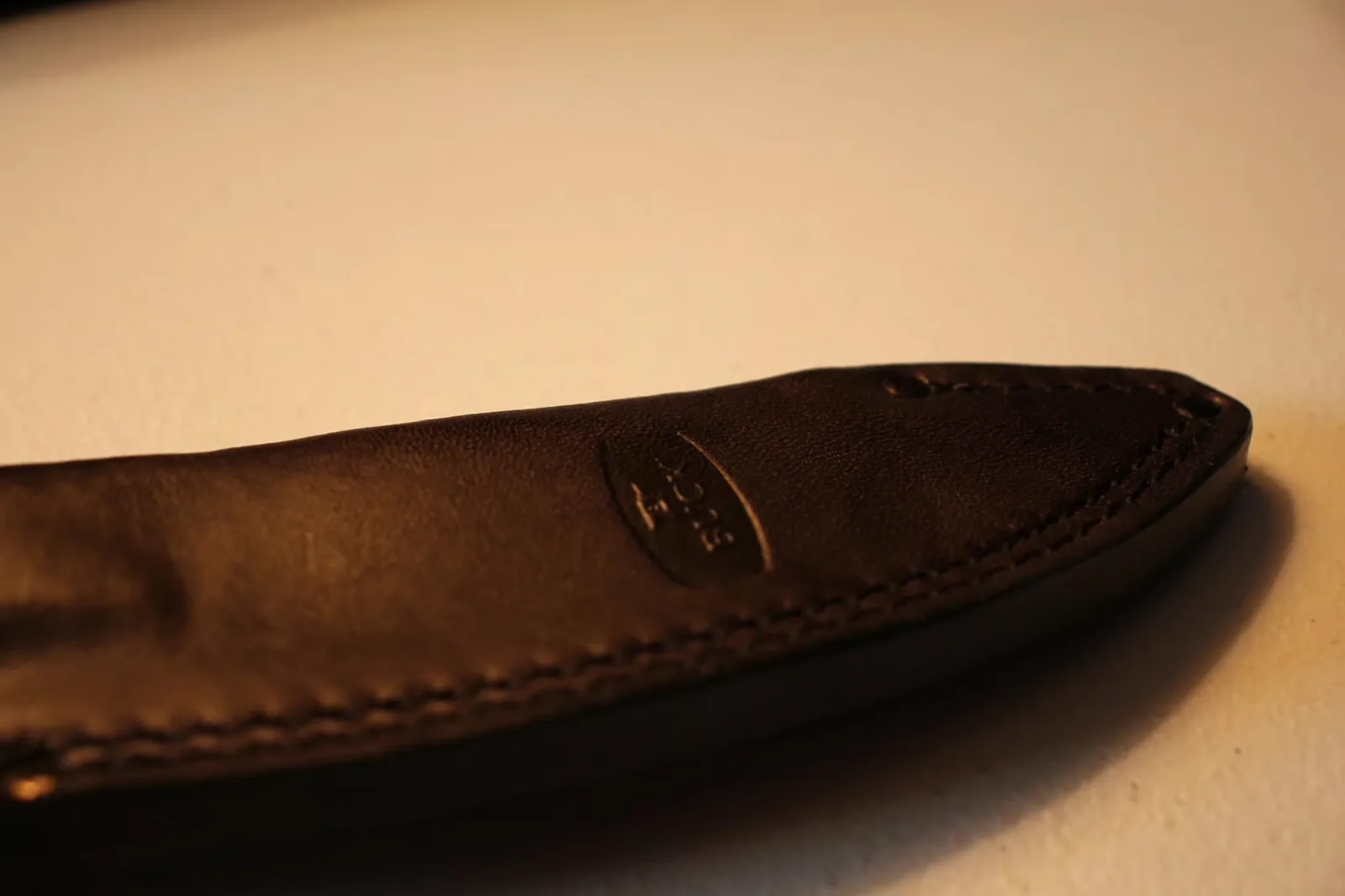
The strap carries the “BUCK KNIVES EST 1902” stamp, and there’s a Buck shield logo embossed at the throat of the sheath itself.
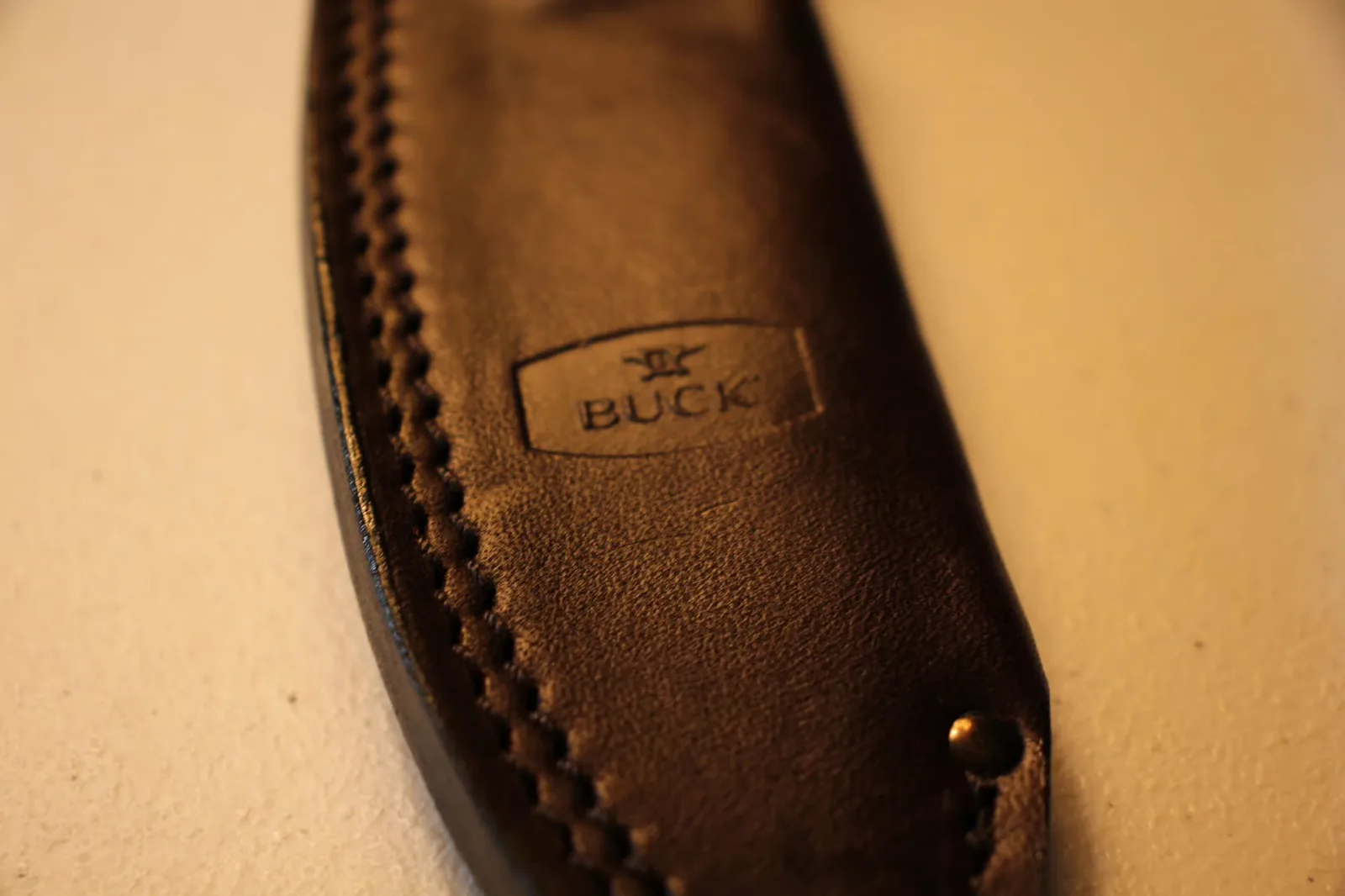
The side profile shows the BUCK logo and a clean leather edge with no ragged spots.
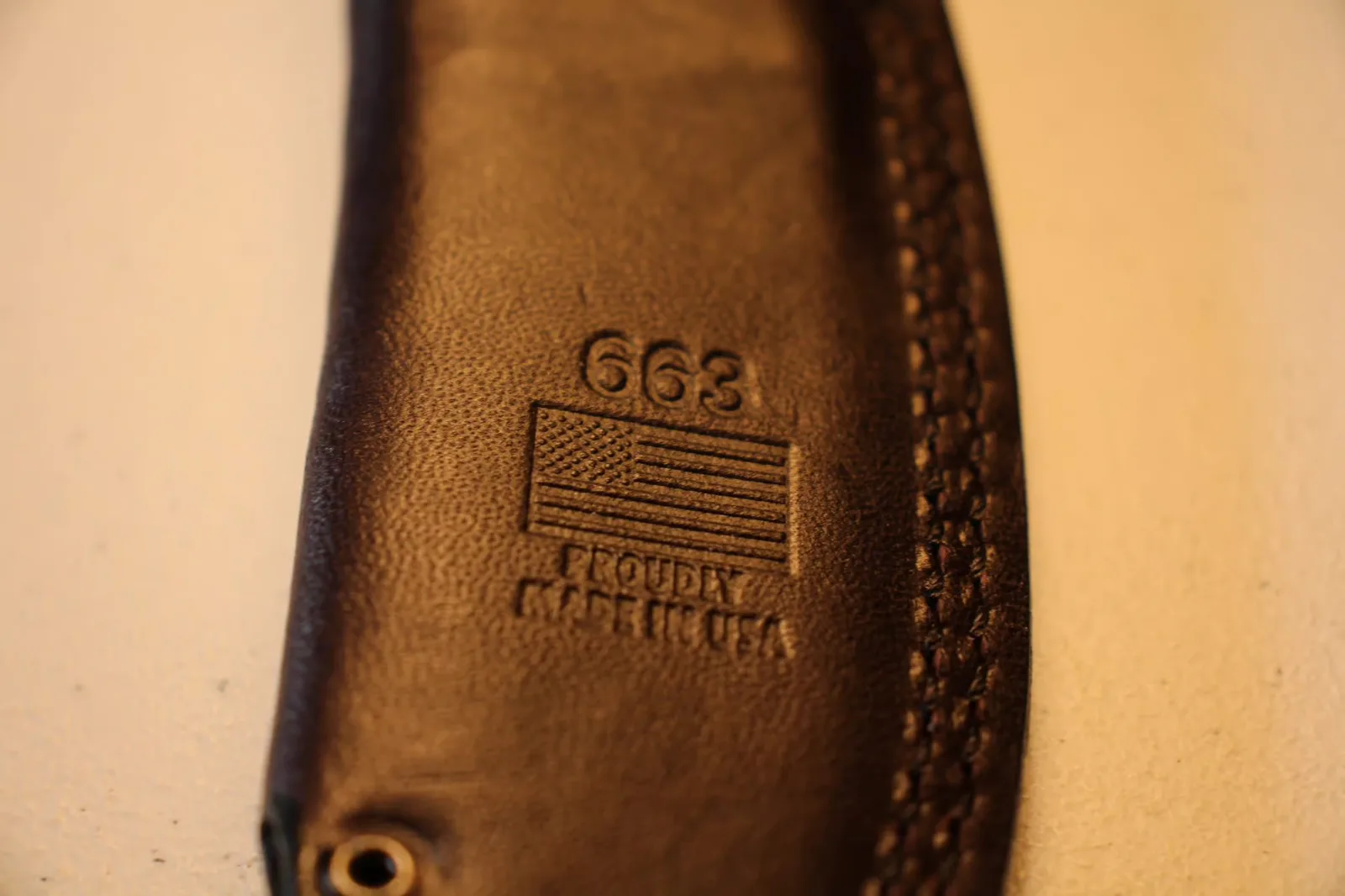
Flip the sheath over and the bottom carries the “663” model number, an American flag, and a “PROUDLY MADE IN USA” stamp. This isn’t marketing decoration — Buck’s sheaths are made by US leatherworkers, and the construction shows it.
A note for wet-climate users: leather always benefits from waterproofing. A first-day treatment with Sno-Seal or mink oil will let the sheath shed rain, snow, and creek splashes without absorbing water. If you live in the Pacific Northwest or the Southeast, do this on day one.
How It’s Built to Be Used
A spec sheet only matters when you map it to actual work. Here’s how the 663’s design choices line up with the tasks a guide knife is asked to do.
Batoning
A 4.5-inch blade is on the short end for batoning, so this isn’t the knife to bring when you need to split 6-inch oak rounds — you’d want a dedicated chopper or hatchet for that work. But for processing kindling out of 2- to 3-inch wrist-thick stock, the geometry is right: a thick 0.165-inch spine to take baton blows, a flat grind that releases cleanly out of wood instead of binding, and full-tang construction to absorb shock without flexing. S35VN is also hard enough that you’d reasonably worry about chipping into knots — but BOS-treated S35VN is one of the toughest executions of this steel, and the consensus among long-term owners is that chipping isn’t a real-world concern with the heat treatment Buck runs.
Food Preparation and Game Processing
The drop-point geometry is purpose-built for skinning and field-dressing: enough belly to sweep cleanly through hide without nicking through, fine enough at the tip for close work around bone and joints. The G10 handle’s diamond texture is one of the few non-rubber materials that maintains grip through wet, slick, fat-coated hands — exactly the conditions you encounter caping a deer or splitting a brisket.
For camp food prep, the same geometry slices cleanly through tomatoes, onions, and cured meats without crushing. It’s not a kitchen knife — the spine is too thick for fine slicing — but for one-knife camp duty it’s a meaningful step up from thicker survival knives like the ESEE 4, which can crush soft food before they cut it.
Fire Preparation
The 663 ships with a squared-off spine — flat 90-degree corner, no rounding. This matters because it’s what throws sparks off a ferro rod, and most knives that ship with a rounded spine require you to file them flat before they’ll work as a fire-starting tool. Buck got this right out of the box. A firm scrape against a ferro rod produces the kind of bright, hot shower of sparks that lights damp birch bark or dry cedar shavings on the first or second strike.
The flat-grind geometry is also well-suited to scraping fine tinder — fatwood shavings, cedar-bark fluff, paper-thin curls of dry pine — without grabbing or tearing.
Fine Carving
Feather sticks are the classical test of a survival knife. The 663’s combination of features makes them straightforward: a high flat grind that bites cleanly into wood, a small sharpening choil that lets you choke up close to the edge for control, and aggressive spine jimping that locks your thumb in place during long, even strokes. Owners report producing long, paper-thin curls easily — and S35VN’s edge holds up across many sessions before needing a touch-up. The same combination handles tent stakes, pot hooks, and trap triggers cleanly.
Edge Retention
This is where S35VN earns its price difference. Compared to 1095 carbon steel (used in the ESEE 4 and most budget bushcraft knives), S35VN holds an edge roughly 2-3x as long under similar use — the difference between needing to re-sharpen every three weeks of daily camp use versus every six to eight weeks. That’s the practical case for the steel upgrade.
The trade-off: when S35VN does need sharpening, it takes longer at the stones than simpler carbon steels. Diamond plates cut it efficiently; ceramic rods don’t. A small DMT credit-card diamond stone in your kit handles field touch-ups without drama.
Pros and Cons (the Honest Version)
What this knife does exceptionally well
S35VN with BOS treatment delivers reference-grade edge retention. The G10 handle is the best non-Micarta handle Buck has ever shipped on a fixed blade. The leather sheath is genuinely premium and made in the USA. The spine jimping and the squared edge make this an excellent fire-prep and detail-carving knife straight out of the box. The full-tang build, exposed pommel, and lanyard hole give you everything you need for hard use, plus Buck’s lifetime warranty backs the whole package.
Where it falls short
It’s $229. That’s the real con. You can buy a Morakniv Garberg for under $100 and do 90% of what the 663 does. The polished satin finish picks up scratches and a faint patina from hard use — fine if you bought it as a working knife, mildly annoying if you wanted it to stay pretty. S35VN, while exceptional, requires a little more sharpening discipline than carbon steels. And the leather sheath, while beautiful, needs day-one waterproofing if you’re in a wet climate.
How It Compares
vs. Morakniv Garberg ($90). The Garberg is one of the best value survival knives ever made — full-tang 14C28N, ferro-rod-ready spine, comfortable rubber handle. It is genuinely 90% of the 663 at 40% of the price. The 663 wins on steel (S35VN > 14C28N), handle materials (G10 > polyamide), sheath (real leather > plastic), and lifetime warranty. If you’re on a budget, buy the Garberg without hesitation. If you want a one-knife-for-the-rest-of-your-life purchase, the 663 is worth the upgrade.
vs. ESEE Bravo 1 ($230). The Bravo 1 is the closest direct competitor by price. It uses 1095 carbon steel — tougher than S35VN, but rust-prone and requires constant maintenance. Bravo 1’s Micarta scales are warmer in the hand than G10 but offer slightly less wet grip. Bravo 1 ships with a Kydex sheath, which is excellent for retention in hard use but lacks the heritage feel of Buck’s leather. This is a real toss-up: pick the Bravo 1 if you live in a dry climate and prioritize toughness. Pick the 663 if you live where there’s water and want set-it-and-forget-it corrosion resistance.
vs. BPS Knives Bushcraft Black ($65). The BPS is a budget bushcraft cult favorite — oak handle, carbon steel, leather sheath. It’s a beautiful knife for the money but it’s one tier of build quality below the 663 in every measurable way: handle attachment, steel performance, sheath construction, edge retention. The 663 is what you graduate to.
Who Should Buy the 663
Buy it if you want a fixed blade you’ll carry for 30 years. Buy it if you live in a wet climate and you’re tired of babying carbon steel. Buy it if you want the heritage and warranty of a US-made knife from a 120-year-old manufacturer. Buy it if you’ve already cycled through three or four cheaper knives and you’ve decided to stop.
Don’t buy it if you’re new to survival knives and don’t yet know what you actually need — start with a Morakniv Garberg, learn what matters to you, then upgrade if and when you’re ready.
Final Verdict
The Buck 663 Alpha Guide is one of the best executions of the modern survival knife I’ve used. The materials are right (S35VN, BOS, G10, real leather), the build is right (full-tang, even grinds, perfect heat treat), and the details are right (squared spine, aggressive jimping, sharpening choil, lanyard hole, snap-retention sheath). At $229 it isn’t cheap, but everything that costs money on this knife is something you actually use.
If you’ve been holding off on a “lifetime” survival knife waiting for the right one, this is the right one.
Rating: 4.8/5 Stars
Brands sometimes provide samples for review. Hunt & Live writes its honest opinion either way — gear that doesn’t earn its keep doesn’t get a recommendation.